![]() |
![]() |
|
|
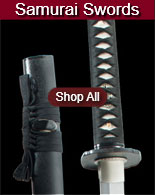
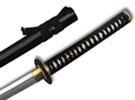
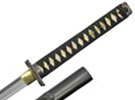
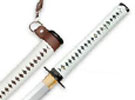
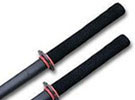
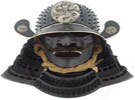
![]() Samurai and Japanese Swords Terminology - The legend of the Samurai The Samurai were a feudal military caste that assumed power in 12th century Japan. They were the guardians and administrators of the Great Japanese feudal families, the Daimyos. The word Samurai meant guard, and was used to describe anyone bearing arms, but later became the name used for these legendary noble knights. The Samurai reigned for several centuries until 1867, when Emperor Meiji abolished the Tokugawa Shogunate and returned ruling power to the throne. The Samurai followed the Bushido code of respect and mastery of the sword. This code was based on honor, bravery, and service. The Samurai were ready to die at a moments notice for their code. The primary weapons of the Samurai were the Daisho. These two swords, the Katana (long sword) and the Wakizahi (short sword), originally called Tanto, were worn through the belt. An earlier version of the Katanas worn suspended from an intricately braided belt was called the Tachi. The guards (Tsuba), pommels (Kashi), and handle ornaments (Minuki) were elaborately decorated on these swords. The handles (Tsuka) were usually Rayskin covered with a silk cord wrap (Tsukaito). Blade were laboriously heat treated showing a visible temper line (Hamon) above the edge (Yakiba). This scabbard was made of wood. Some swords had extra small knives (Kodzuka) mounted in the sides (Shuriken) and throwing stars mounted to the guard. These sacred weapons were called the "Soul of the Samurai" (Nippon - To) and were called the "Soul of the Samurai" (Nippon - To) and were only made by very skilled craftsman. They were highly treasured collectibles today. © 1997 United Cutlery Corp |


|
|
|
|
|